Just Gliding Along...
size matters....

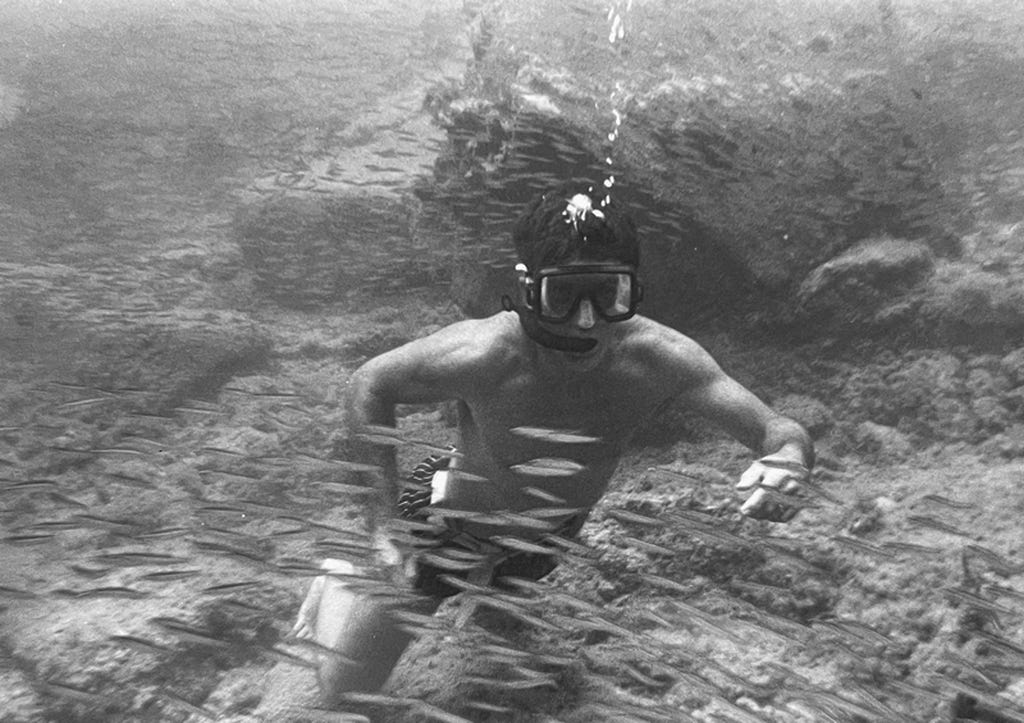
I used to swim a lot. One thing I really loved about swimming was seeing how far I could glide after a couple of really strong strokes. This was especially nice under water where drag is less and gliding is like flying (or I imagine flying to be). With a couple of energetic strokes, I could achieve a speed of about 1 meter per second, sort of a good speed for a non-competitive athlete, and without any more propulsive effort, this launched me on a long glide that finally petered out at about 5 meters.
During such a glide in the glass-clear waters of Wakulla Springs, I could watch the fishes doing their own glides, and it became obvious that with some effort, small fish could match my swimming speed, but their glides always fell well short of mine. Why was that, I wondered (OK, full disclosure, I only began to wonder about this much later in life, and not while swimming in Wakulla Springs)? If they can swim as fast as I can, why can’t they glide as far? They’re experiencing the same water, after all, more or less. But then, come to think of it, whales and big fish seem able to glide a lot farther than I can, even if they are just lazing along.
It came to me that these gliding differences resulted from (hang on!) the relationship between the kinetic energy of movement and the viscous resistance of the fluid, a dimensionless ratio called Reynold’s Number (Re). This ratio helps me (and anyone who cares) understand the way creatures and objects move through fluids, be the fluids water, air or syrup, how fluids flow through pipes or around objects, how airplanes fly and ships steam, how rivers meander, how falling objects reach a terminal velocity in air, water or syrup, and other wondrous things about the world we live in. Reynolds number is small for small objects, low velocities, and low viscosity, and large for the opposite. My essays involving Reynold’s number can be found here, here, and here.
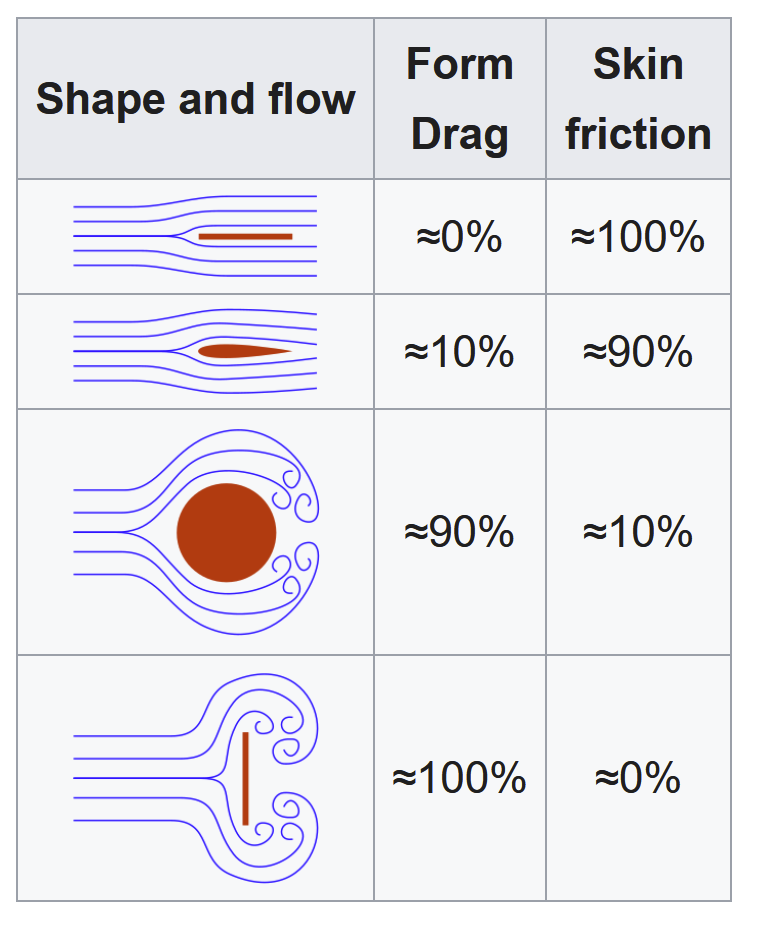
When an object moves through a fluid, or fluid moves past an object, there are two “drag” forces that act counter to that motion: friction with the object’s skin, plus turbulence or eddies created by the motion. Both types of drag sap the object’s kinetic energy and slow it down. Drag acts only on an object’s surface, and because small objects have a lot more surface per unit volume, drag per unit volume is greater for small than large objects. Drag also increases with the viscosity of the fluid, but as this essay is only about water, we can ignore differences in viscosity. The relative importance of these sources of drag depend on the shape of the object, as in the table below, but also on its speed. With an increase in speed, total drag increases, but skin friction (streamline flow) becomes smaller relative to turbulent flow. As a general rule, laminar flow (skin friction) dominates when Re < 2300 and turbulent flow (form drag) when Re > 2900. A streamlined shape can keep flow laminar up to higher speeds, accounting for the similar shapes of fast-swimming fishes, jet planes, and whales .
Now back to my observations while gliding in Wakulla Springs. As I swam at about one meter per second, my Reynold’s Number was around four million, that is, the kinetic energy of my motion was about four million times greater than the water’s friction/drag that slowed me down. It took about five meters for the water to sap all of my kinetic energy and bring me to a stop.
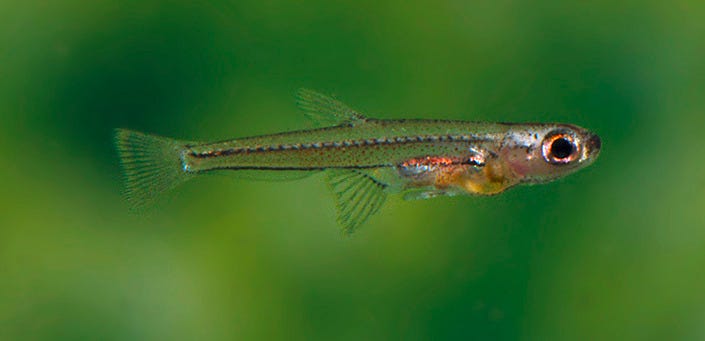
Now consider the little fish that I shared the spring with. It is swimming in the same water with the same viscosity, but its mass is perhaps about one millionth of mine, and thus its kinetic energy while swimming is proportionally much smaller, giving it a Reynold’s Number of about one or two. This means that water’s friction (drag) saps its small kinetic energy in a short distance.
Or turn the reasoning toward larger creatures. Whales swimming at leisurely whale speeds have Reynold’s numbers of about 400 billion. The friction of water is almost trivial compared to their huge inertial energy. A whale swimming at my speed (one meter per second), like the humpbacks in the video below, could probably glide about 50 times as far as I managed. To a whale, swimming probably feels like flying would to me (if I were buoyant in air)—- moving through a fluid that exerts almost imperceptible resistance to my movement.
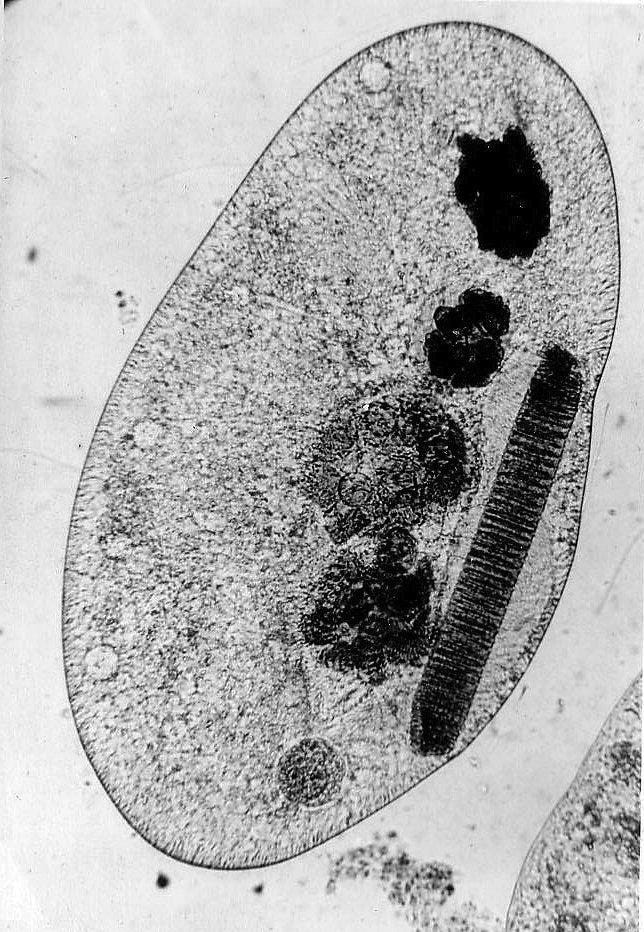
For all swimming animals, their post-propulsion glide (“stopping distance”), decreases greatly as their body size decreases, until for very small animals, it is essentially non-existent. This made me think back to the many hours I have watched really tiny swimmers under my microscope. A swimming Paramecium has a Reynold’s Number of about 0.1, which means that the viscous resistance of water is ten times the energy of motion of this tiny swimmer. When its cilia stop beating, the little creature simply stops—- there is no glide, no coasting. The same is true for rotifers, crustacean larvae and most other creatures in this size range.
At the size of a bacterium, viscous resistance is about 10,000 times the energy of motion, and for an amoeba, it is about a million. None of these microscopic creatures manage to coast at all. When their propulsive force stops, they stop.
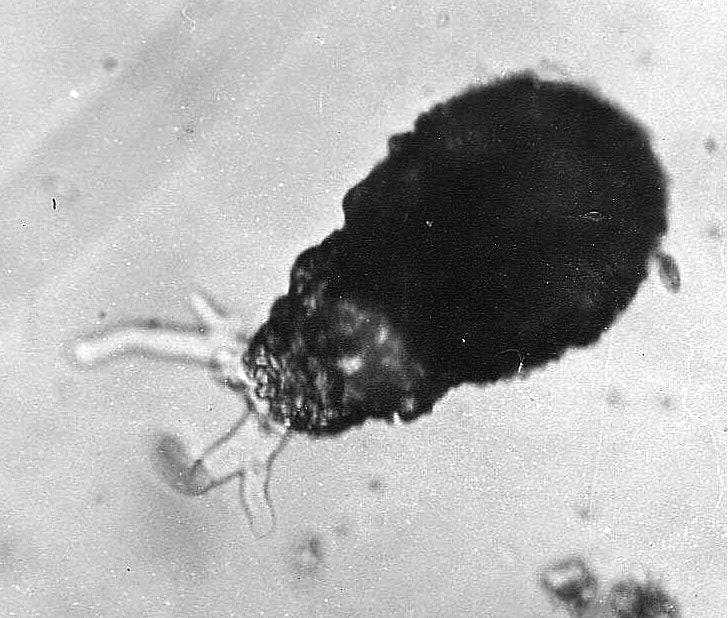
In essence, for such tiny creatures movement is all push and no glide. They do not swim in the sense we do, they drill their way through jello. That’s what it would feel like if we were their size. Next time I enjoy the pleasures of a glide among the fishes in Wakulla Springs, I will be grateful for my large size.
Thanks for the fascinating article. My aeronautical engineering friends in college told me that fluid dynamics was the most complicated part of their studies with a single equation going on for more than two pages.