Meandering
Life is not straight

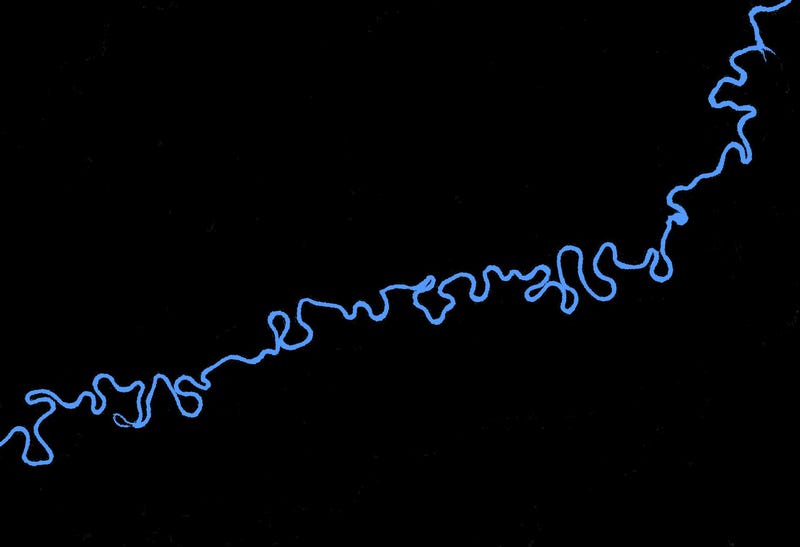
When I think about describing my life in research, the metaphor “meandering” often comes to mind. The dictionary defines meandering as “moving slowly in no particular direction or with no clear purpose.” That seems like a fair description of the many switches of direction, accidental discovery, growth and retraction that was my research life—- exploration with no ultimate goal in mind. As I investigated each problem, another question suggested itself, and “the another” was not easily predicted. How else can I account for wandering from my training in biochemistry to research on the sex pheromones and defensive secretions of tenebrionid beetles, then probing the evolution of their internal anatomy through hundreds of dissections, followed by what role crowding played in their life histories, then drifting on to how a fire ant queen’s egg laying rate was socially controlled, how the huge range of fire ant worker sizes develops during colony growth, and how this range serves division of labor, how fire ants start new colonies, how they defend territories, share food, forage, and other angles on fire ant biology. Each project required different skills, from fine dissections in which a tremor meant disaster, thousands of pen and ink drawings, some electron microscopy, a little organic synthesis that yielded pretty yellow crystals, a lot of NMR, UV, and IR spectroscopy, behavioral studies, field methods, plot designs, statistical analysis, gizmos and contraptions, melting metals in the field, and learning how to identify dozens of ant species while studying their natural history and nest architecture. I am leaving out some stuff, mainly to keep from droning on.
I like this metaphor, in part because I love the patterns made by the restless wanderings of meandering rivers as they snake back and forth over the landscape, constantly changing their routes, abandoning old channels and cutting new ones, short-circuiting loops to leave dark, motionless swamps behind. I am not sure why I find meander patterns so pleasing, but I do, perhaps because my wandering interests and enthusiasms share something with these meanderings of rivers.
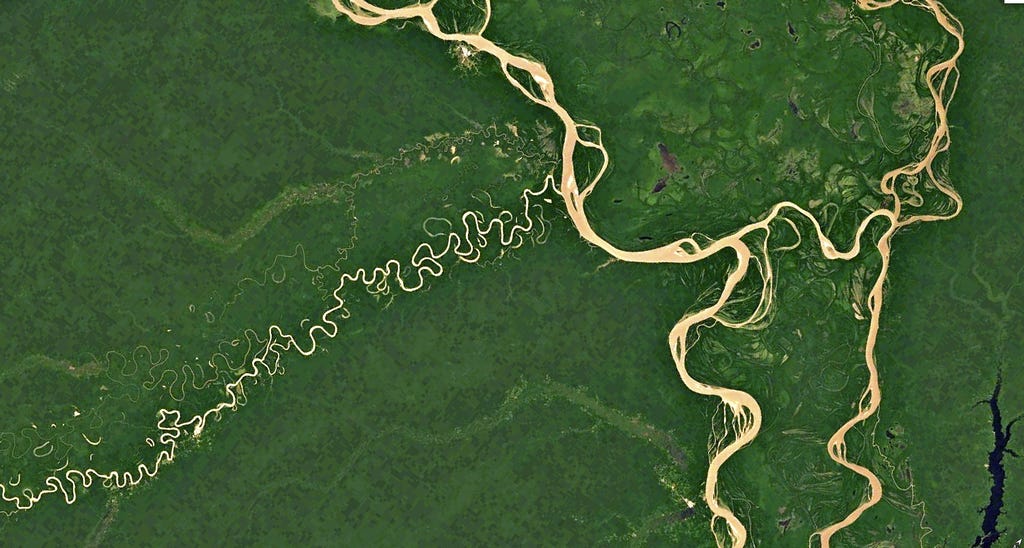
It took me a long time to understand why rivers meander— I had read the explanations, but it had never really congealed. The forms that rivers, and tentatively, lives assume turn out to be a question of energy and work: sometimes flowing fast, sometimes slow, but always with the expenditure of energy. Water is pulled toward the earth’s center by gravity, giving it potential energy that is converted to kinetic energy through flow, the energy of motion and work (work is defined as the movement of mass—- in this case water and suspended, eroded sediments—- through distance).
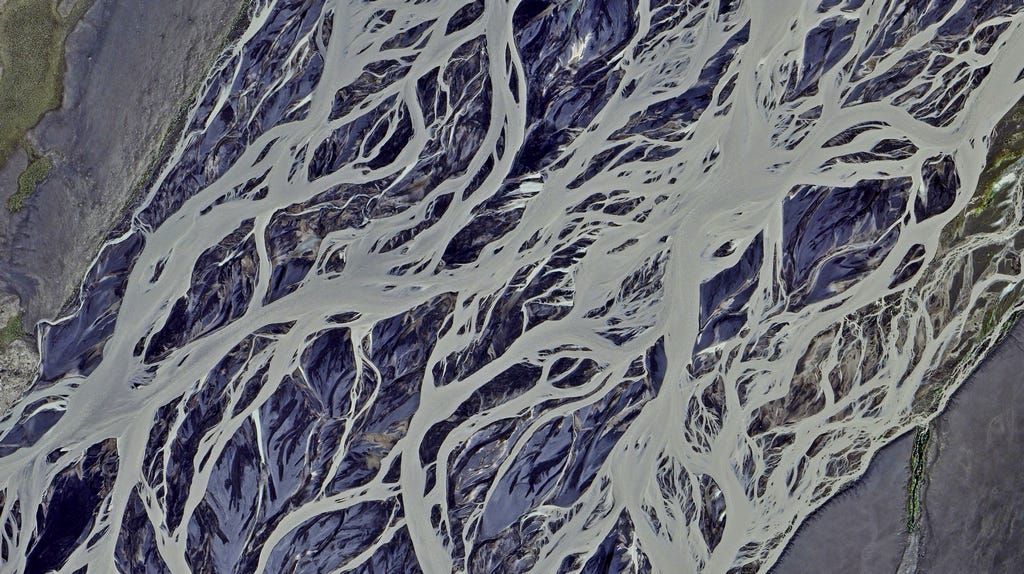
The faster the water flows, the more work it does. Up near the headwaters the slope is steep, the flow is fast, the kinetic energy is high and the work done is great. The fast flow moves coarse sediment swiftly, re-depositing it equally swiftly, making the river channels unstable so that the water switches easily among multiple channels to form a braided stream—- you can watch it happen. When we and the river are young, our kinetic energy is high, our development is fast and changeable, and we are a braided stream high in the mountains. We jump from channel to channel as we try to find a good course for our lives, and we move a lot of stuff around. The size of the objects moved is highly dependent on flow rate. I once watched an extreme flood of the Feather River in California—- the ground shook as the water tumbled rocks the size of cars. Like a river, when life is in flood, you can move large objects.
But as the river reaches the plain, the stream’s gradient becomes low, and the kinetic energy of the flowing water, and therefore work and erosive power diminish, as does the coarseness of the transported sediment. To bring the work into line with the slope of the plain, the river lengthens its channel by meandering, minimizing the slope along the stream’s mid-line and therefore minimizing the work done.
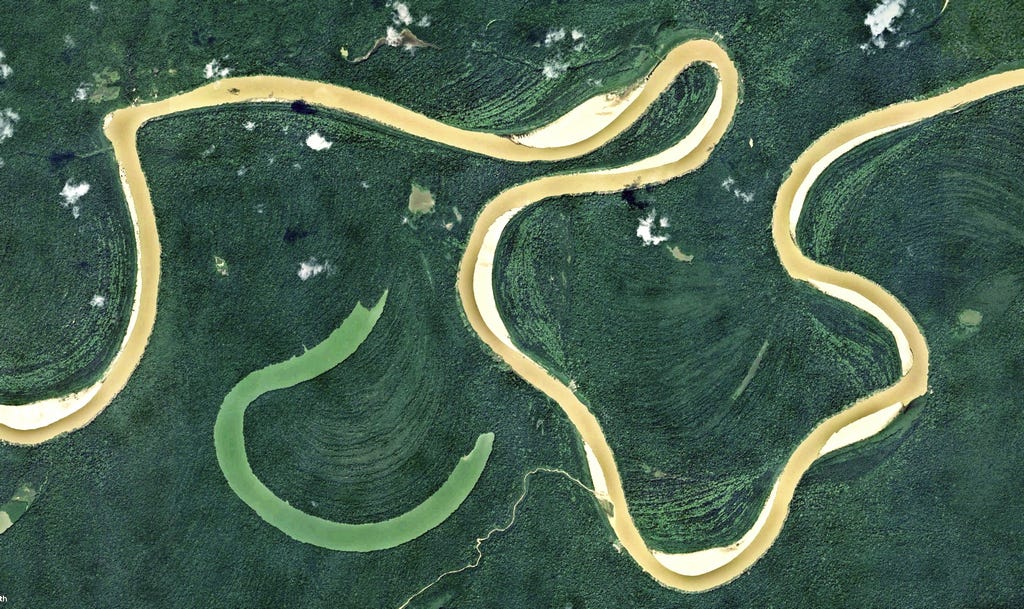
Picture a river flowing straight down the slope of even a gentle plain—- any irregularity, lateral deviation, or obstruction in the stream bed causes the water to flow faster over or around that point, thereby locally increasing its erosive power and increasing that irregularity. But the stream’s total flow cannot be changed, so that there is slower flow on the side away from the obstruction or irregularity, and the material eroded from the “fast side” is deposited on the “slower side” a little bit downstream, giving the stream a bend. The more the channel bends, the faster the water must flow on the outside of the bend, carving the bend ever more, extending the meander loop. Integrated over the lengthened, meandering path, the river’s flow speed and therefore the work done is minimized and distributed uniformly along the length of the stream. You can watch this happen over 26 years in the video below.
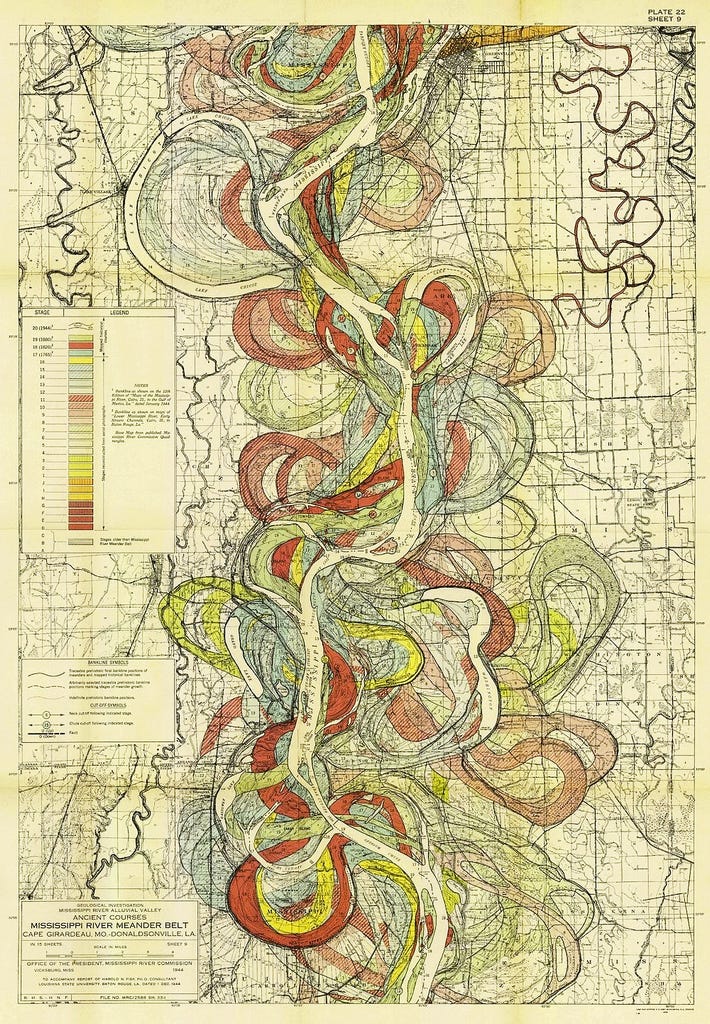
Over time, the meanders propagate downstream and the river forms a meander belt across whose width the meanders sweep over and over as the centuries drift along. Such a meander belt was thoroughly mapped for the Mississippi River, meander over meander, geological art year by year, century by century.
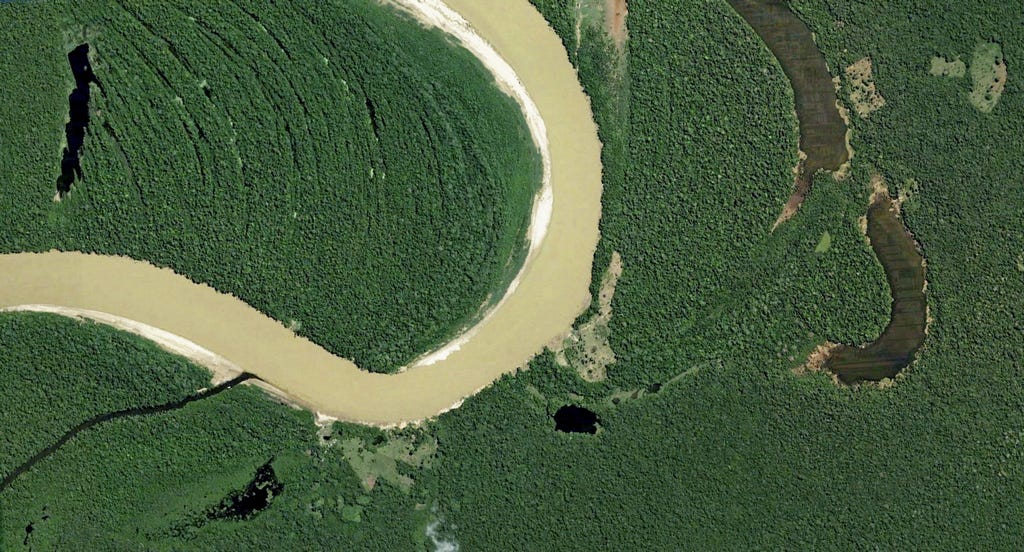
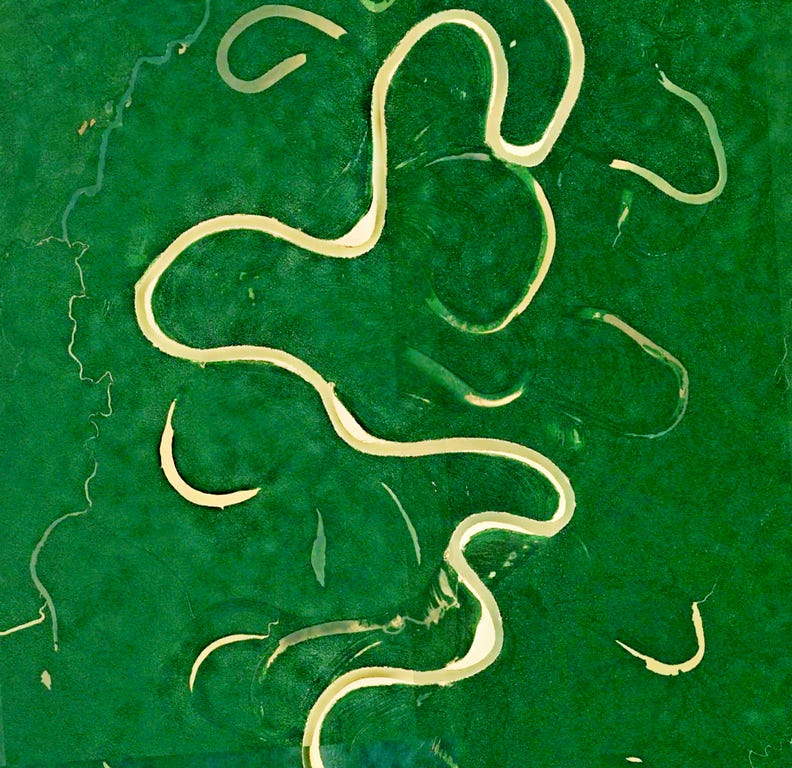
With time, the stream of life, like that of the river becomes less steep, its kinetic energy lower, and it tends to stay in the same channel. Like the river, this channel is not fixed; rather it meanders gradually with time. We work intensely on some aspect of our life, but as time goes on, the payoff decreases, and we discover new areas for our focus and energy, and divert energy from older meanders, eventually abandoning them entirely, leaving behind an oxbow lake, a memento of our past. The final meanders of my life have been very long ones—- a giant field experiment on ant ecology, several meanders through the architecture and biology of underground ant nests, including making casts with molten aluminum in the field, followed by a book on this subject. As the stream of my life approaches the sea, I look back to see that I have left a lot of sediment behind. Now I make quiet, pleasurable, and slow observations of a very tiny and peculiar ant, I thrill each spring to the emergence of miner bees, I sing with the green tree frogs on humid evenings, I take note of the scarlet spears of coral bean flowers that shoot up each year, and I keep my eye out for aphids tossing their poop to keep clean and healthy.
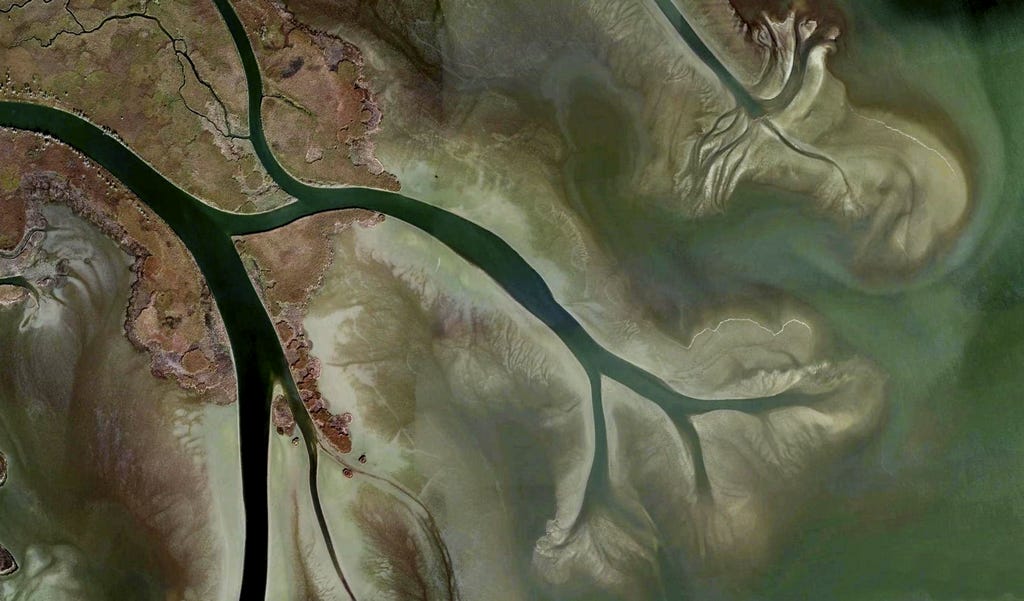
As a river reaches the sea, it gives up its remaining sediment load through distributaries to form a delta. Is it stretching metaphors to think that the furniture I have built and the many stories and essays I have published on Substack are my delta, a delta that still grows, that is still making land? The delta is how we enter the sea.
Once again, dear Walter I am mesmerized by your calm, steady, teacherly brilliance. This essay is wonderful and I am quite gratefully in your debt.
You have surely built a rich and wondrous delta! You've inspired and fueled the curiosity of so many along your teaching career, spurring many to examine branches of study attuned to each one's particular interest. The path we each travel through our lives definitely meanders with amazing repetitions and reintroductions of present-tense to past. Thank you for sharing your vision with each of us.