Security in Guyana
To sleep peacefully ...

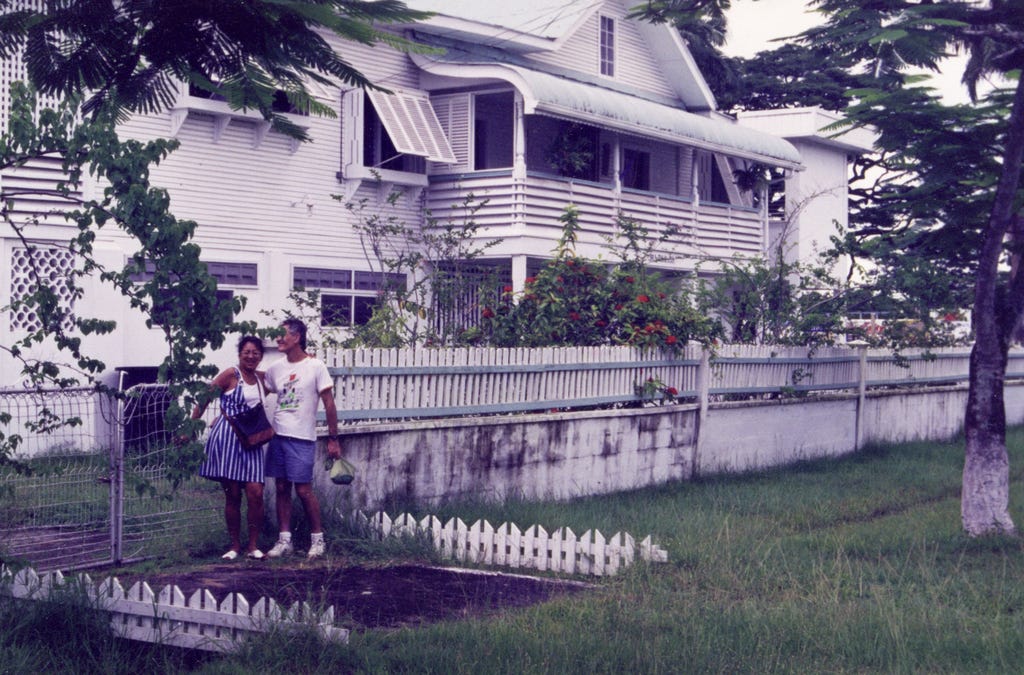
Introductory Note: my older brother, Henry (1938-2021) spent 37-years in international development, mostly in relation to tropical forests. He was employed by a veritable alphabet of international and government agencies, working in Costa Rica, Colombia, Tunisia, and Honduras, and was Forestry Advisor to USAID for all of Central America. His most lasting contribution was to head an ambitious international effort in Guyana to develop sustainable forest management on a huge area of pristine rain forest. The following is Henry’s account of an incident during his time in Guyana. I took this story from his memoirs and have edited it to a moderate degree. WRT
Henry: security in Guyana, 1996
Georgetown, Guyana is not an easy place to live. Petty crime is a serious problem, and there is no real ready-made entertainment here, unless you like Kung-fu and movies from India. After surviving years of socialism, Guyana’s shops are just beginning to stock up with consumer goods, usually a bizarre mixture in small lots. Maria’s greatest consumer accomplishment was finding four bags of black beans. She is still on the hunt for the ingredients of tortillas.
Since there is not much to do, a decent house becomes more important. As in any small town, one has to be creative. We actually have had an active social life, partly because people want to check us out. After our first year in Georgetown, we moved into the upstairs of the white wooden, Victorian-style house of Oliver Hinkman. Windows on all fours sides, lacquered wooden floors, shaded by Caribbean style shutters that gave good cross ventilation, a necessity in the muggy tropical weather of coastal Guyana. The front windows faced Church Street with its sparse traffic and the sluggish, murky waters of the main drainage canal. Oliver was a cheerful, hefty black man who inspired confidence. He lived alone, except when his voluptuous girlfriend stayed over. He was a pleasing landlord, always asking, “How yo’ doin’ up thare?” Whenever, we had a problem with the raised water cistern or anything around the house, he would send a workman to fix it. One would never suspect that he had been the head of military intelligence in Guyana under the previous dictatorship. Because he had murdered a man, he had to leave the country for 15 years, only recently daring to return to make a new life here running his bakery. Judging from the stream of sleazy visitors that came and went downstairs he must have been operating more than a bakery.
In Georgetown, people of means, especially expatriates, hired private guards for their homes. In our previous house, we had contracted a company for a night guard. Most were women, dressed in ill fitting, dark blue uniforms and armed with nothing more than a big stick. Usually, if we arrived home late, I would find our valiant protectress sitting on the porch, with her head down on the table. I felt mean arousing her from her peaceful sleep so that we might sleep peacefully that night.
Everyone told us that a guard would not be necessary for Oliver’s house because he was a feared and respected man. However, evidently not all thieves knew this, because one Sunday morning, with the sun already brightening our living room, I called out, “María, did you move my laptop computer?” “Of course not,” she mumbled still half asleep. “Hey, and where is my backpack with the video camera?”
We knocked on Oliver’s door downstairs. He was not at home. We phoned the police. The two policemen seemed efficient. They identified the window of entry, dusted it with a white powder to record fingerprints, asked the right questions and had us sign forms. A total of about US$4000 worth of our stuff was gone plus the priceless information on my computer.
What was most disconcerting was that some of the stolen stuff had been stored under the bed in which we had slept soundly that very night.
Oliver was furious and felt insulted. Someone had intruded into his territory. The next night and every night thereafter, his muscular friend Andrew slept on our porch. Andrew was the goalkeeper for the national football team. María and I marveled at his physique. One day as I was loading a box so heavy I could hardly lift it, he said “Let me help yo’, Mistah Henry”, swung the box onto his shoulder in one smooth motion and set it down gently in the pickup.

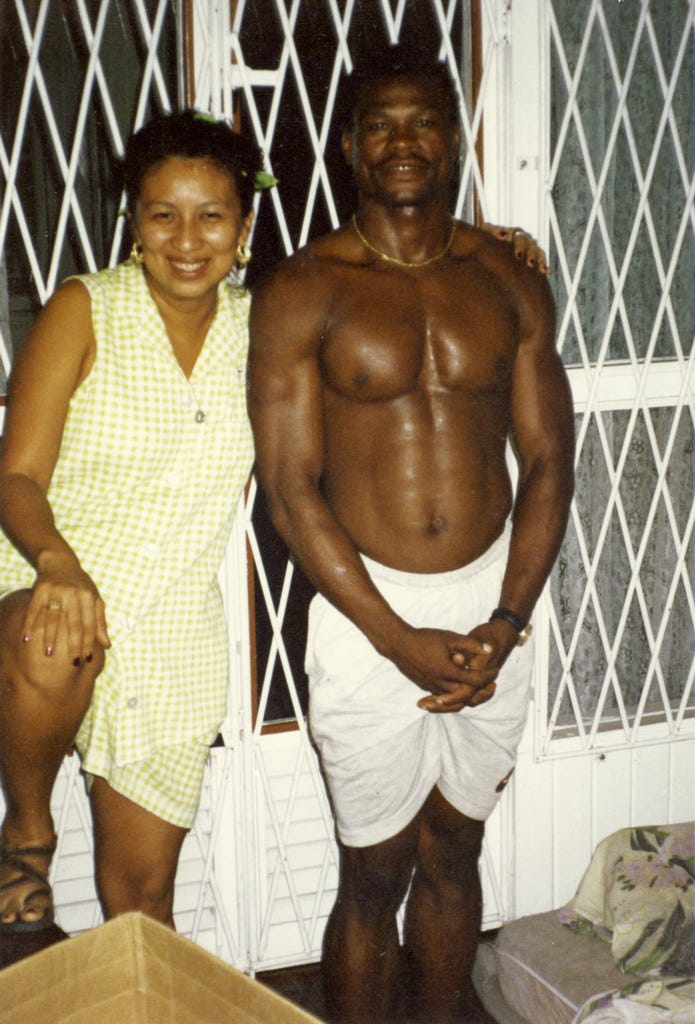
With Andrew stretched out like a watchdog on the mattress out front, machete at his side, we again slept peacefully under our mosquito net.
But Oliver’s pride was hurt. He put his intelligence network to work and began to ask around. After all, the market for laptops in Georgetown was exceedingly small at that time (1996). A week later, Oliver pulled up in his car with three other husky black men. Any one of them alone could instill fear. “Mistah Henry, I think we found yo’ computer. Please come along.”
I quickly told María whom to call in case I did not return within a couple of hours. I crammed into the back seat between an imposing man a head taller than I and a brawny chap who took up more than his third of the seat while he caressed a club between his muscular thighs. Their faces were expressionless. Nobody said a word.
We drove into a part of town I had never dared visit. Run-down wooden houses on pilings, the stench of a dead cat floating in the black water of the drainage canal, laundry strung on wires with no hope of drying before the afternoon rains on this overcast day, kids playing ball between the potholes on the narrow, muddy, rutted street. Our car stopped and the tall man walked ahead with a limp. For several minutes, we watched him gesticulate and talk with a young man in a torn, smudged Tee-shirt and shorts leaning on a fence.
The young man approached us and leaned in the car window, “Mon, Oliver, if I had known it was from yo’ place I wouldn’t ha’ bought it.” He invited me to come and get the computer. As the only white man in this completely black space, you can imagine my unease at following this shady stranger though alleys and over boards spanning murky puddles. Only the expectation of recovering my precious computer somewhat alleviated my unease.
“But Mistah, yo’ goin’ to pay me somethin’? I had to pay good money fo’ this thing.”
Of course I would. “How much?” “Thity dollahs.”
We clambered up wobbly wooden stairs and entered a musty room littered with dusty, broken furniture and cardboard boxes. He opened a box in the corner to show me a white laptop computer.
In dismay I stammered, “But mine is black”.
Well, would yo’ like to buy this one fo’ $30?”
“No, thanks,” I said.
P.S. Editor’s comment, I don’t know if Henry ever recovered his stolen goods.
Your brother and Maria were very brave people.