Iwokrama
a gift to the world

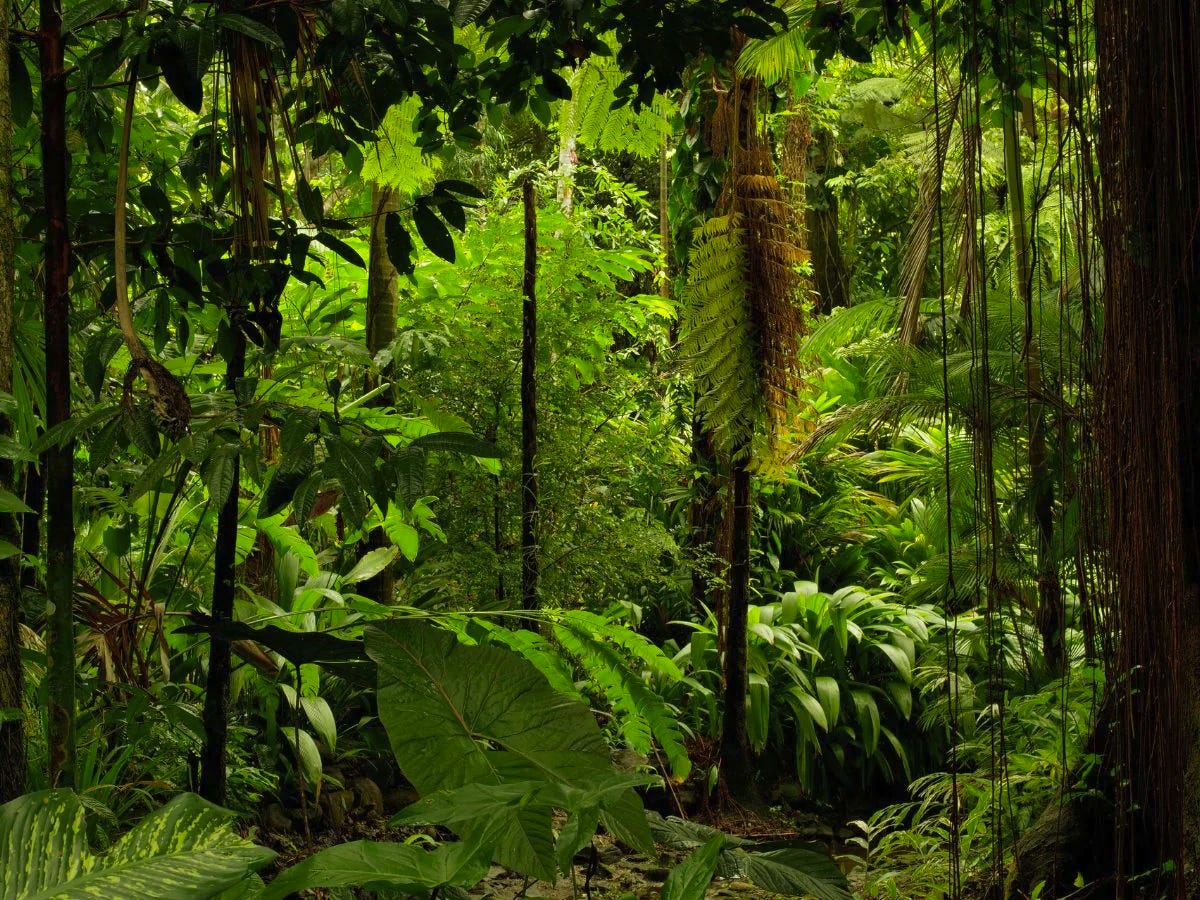
Introductory Note: my older brother, Henry (1938-2021), spent 37-years in international development, mostly in relation to tropical forests. He was employed by a veritable alphabet of international and government agencies and private consulting companies in Costa Rica, Colombia, Tunisia, Honduras, and throughout all of Central America. One of his lasting achievements was to set up an ambitious international effort for sustainable forest management on a million acres of pristine rain forest in Guyana. The following is taken from Henry’s memoirs, with a background note from me. WRT
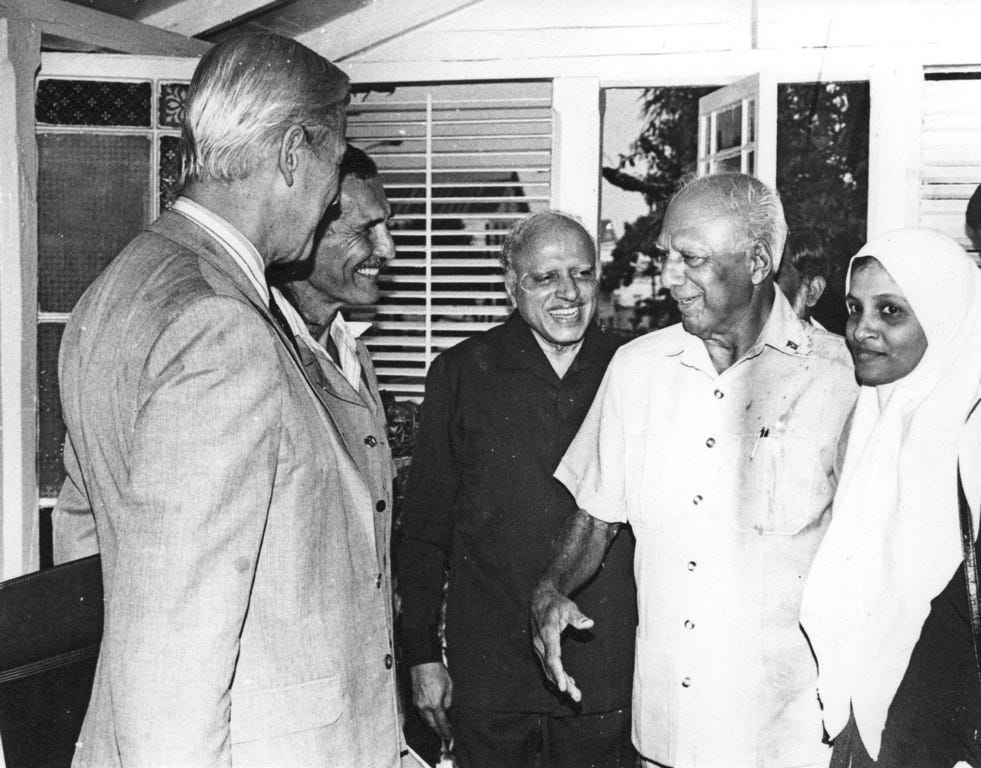
Background Note by WRT: During the 1980s and 90s, the rate at which the world’s tropical rain forests were being destroyed was very much a major issue. At a 1989 meeting of the Commonwealth Heads of Government in Kuala Lumpur, the then President of Guyana, Hugh Desmond Hoyte, offered a gift to the world: Guyana would set aside a million acres of rain forest for an experiment in sustainable tropical forestry and conservation, to be named the Iwokrama International Rainforest Programme. Early in 1990, a Commonwealth Expert Group led by Dr M.S. Swaminathan, then President of the IUCN, along with a Guyanese committee, selected an area of central Guyana that is almost entirely surrounded by rivers -- the mighty Essequibo, the Siparuni, the Takatu, and the Sipariparu. In the north lie the Iwokrama Mountains, which lend their name to the site. The site’s pristine forests, scarcely touched by human hands, represent about 2% of the Guyana’s tropical rain forest. As interim chairman of the Iwokrama board of trustees, Swaminathan assumed a key role in establishing the institutional, operational, research, communication, and strategic framework for the program.
Henry’s Account of Iwokrama Forest
Other than work, there was not much to do in Georgetown. Maria (WRT note: Henry’s wife) and I rapidly exhausted possible nearby outings, because there were only three roads leading out of Georgetown. Anything beyond required some kind of expedition such as my trips to the Iwokrama forest and field station, and if by land, these were considerable undertakings.
For example, on one of our earlier trips, it was after midnight by the time the truck was loaded and the team of 17 young zoologists, four workers, María and I had been accommodated. There was not enough room on the old surplus Bedford British army truck for all 23 of us, plus baggage, to fit onto the two benches along the side, so some had to nestle among the sacks, boxes and barrels of supplies piled along the middle. For the first hour, the truck roared through the night at a fast clip. I sat on a box facing the tailgate and watched the silhouettes of trees that lined the road recede into the darkness. Then at the bauxite mine of Linden, with its moonscape of open pits, the pavement ended. The uncomfortable position, now compounded by the jarring of the washboard road and the stench of a leaking can of kerosene made sleep impossible. At the Demerara sawmill, the truck growled onto a narrow logging road headed toward the wide Essiquibo River, just above the boulders that turned its placid waters into crashing foam.
By the time we reached the muddy shore, groggy from a sleepless night and aching from five hours of relentless shaking, the first timid light allowed us to discern the opposite forested shore, half a kilometer away. We all tumbled out of the back of the truck, stretching our cramped limbs. María, forever attentive to food, had a magical effect on everyone’s humor when she unexpectedly shouted, “Who wants a ham sandwich and hot coffee?” It took over an hour to transfer the supplies and ourselves from the truck onto the three wooden boats waiting on the shore.
For three hours, the outboard engines pushed the boats against the slow current and between the menacing boulders of the occasional rapids. That gave me time to study my travel companions, young Brits, students of zoology headed for the undisturbed Iwokrama forest to make some of the first collections of birds, amphibians and bats. Even after the miserable night, their smooth faces now displayed the eagerness of youth headed toward exotic adventure. They gesticulated continuously toward the shore, passed around the binoculars and, above the roar of the engine, shouted “Hey, is that a toucan on that tall tree?” or, “Look at those caiman tracks, that must be a huge one.” I compared their lanky stature, enthusiastic youthful white faces and proverbial British ruddy cheeks with the expressionless brown face of our short, muscular Amerindian boatman who was concentrating on tiny ripples in the water that signaled rocks just below the surface.
In the middle of the boat was a pile of about 20 kg of fish and meat, including a laba (paca or agouti, a large rodent) which was to enrich the rice that evening. All sustainably hunted and fished, of course. The human population is still so sparse that traditional hunting and fishing is probably sustainable. However, the commercial exploitation of fish and other animals, especially the larger ones such as crocodiles is beginning to be a serious problem. This is the main reason we are planning to recruit and train our first batch of eight rangers.
As I watched the monotonous wall of green tangles slide past, I felt in my element. This is why I had taken the job: directing the management of one million acres of pristine forest, partly for production and partly for conservation. A forester’s dream! Unfortunately, these trips into the forest were all too rare for my tastes. Matters of planning, Guyanese politics, fund raising, orienting consultants and VIP visitors, reporting and other tasks that characterize the management of an international project tied me to Georgetown.
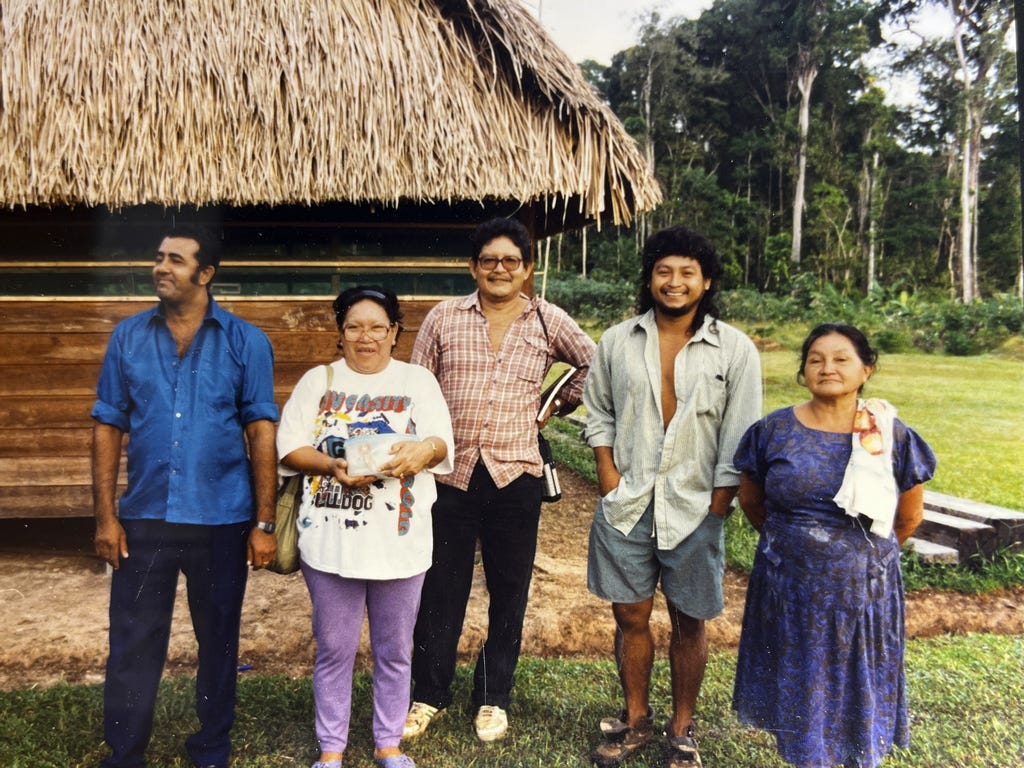
Just when the wooden seat of the boat was becoming completely unbearable, we glimpsed the palm thatched roofs of the Iwokrama forest station. Helpful hands received us and the supplies. I shook the rough hand of Fred Allicock, manager of the station and of the 15 workers, drivers, boatmen and a medic who lived there. Like almost all of these, Fred was Amerindian, but a generation older than the others, a man completely at home in the forest, a repository of knowledge and skills that would be lost upon his passing. Because of this, he was a respected leader, not only here at the station, but also in his Amerindian village at the edge of the forest, two hours away by truck.
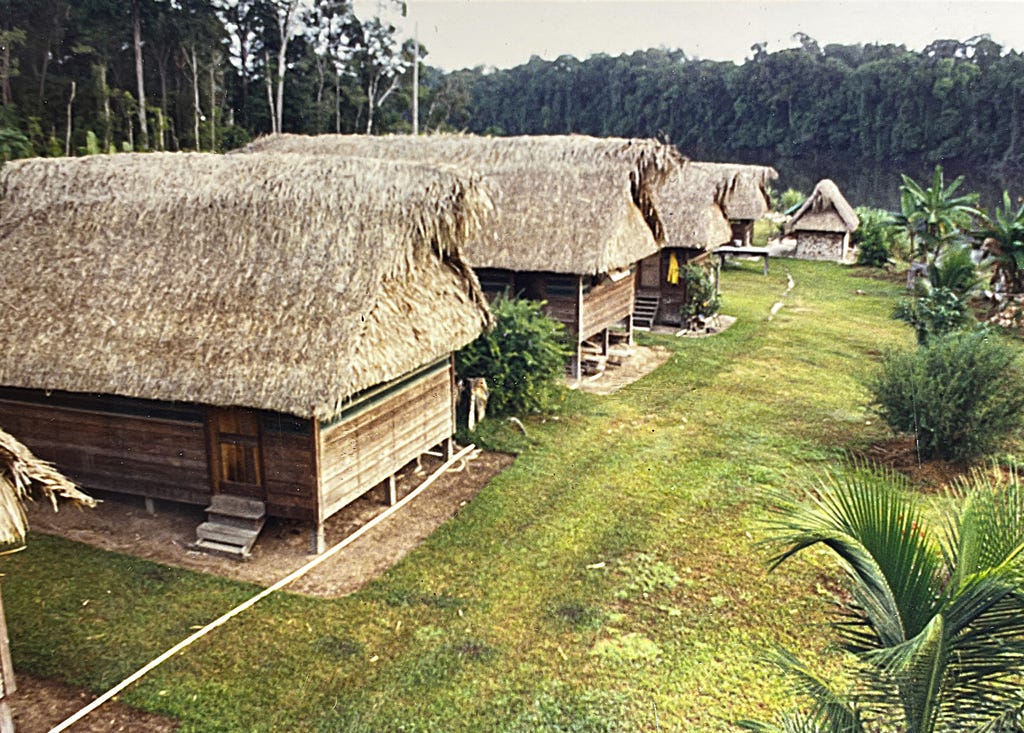
“Welcome back, Mr. Henry”, he greeted me. As we ambled away from the group, in his modest, soft spoken manner, Fred briefed me on the latest developments and plans. “Malaria at the station and Kurupukari village is way down this month, Mr Henry. Every week we line up everyone for the medic to take blood samples. Now that he has a microscope and is trained to use it he can prescribe treatment immediately and quarantine those who are sick. The mosquito nets we distributed have also contributed, as has the dusting with DDT powder.”
The clang of the bell at the mess hall interrupted us. Mrs. Allicock and her two assistants had quickly prepared breakfast of coffee, oatmeal, flat cassava bread and labba meat (aka paca, a large rodent) mixed into the scrambled eggs.
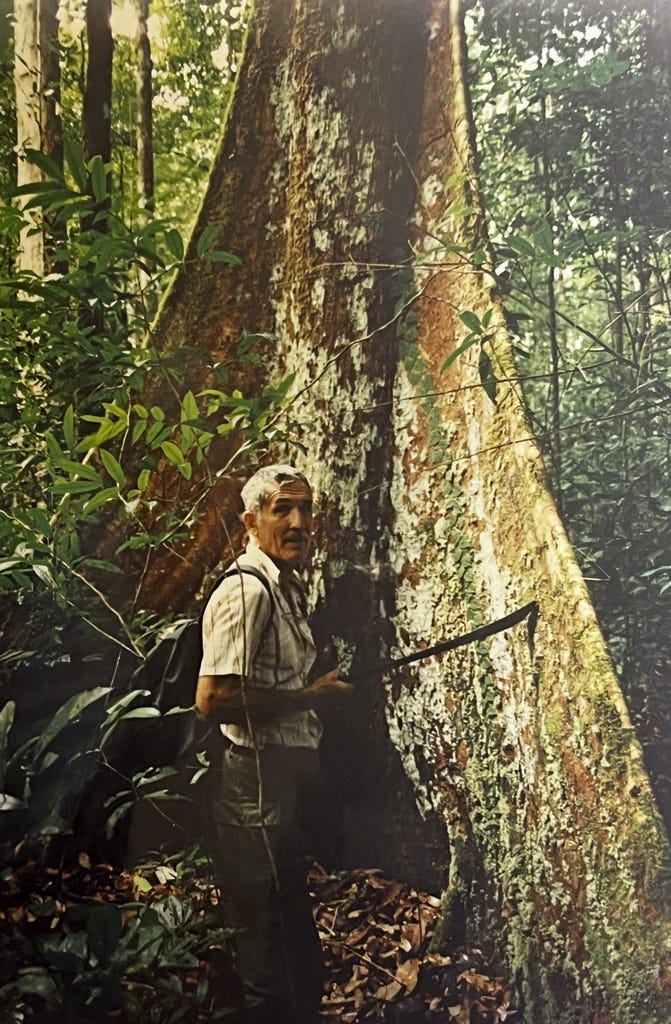
After breakfast, Fred asked, “Mr. Henry, for the benefit of the students, I thought we could take a hike up Turtle Mountain. What do you think?” After only 20 minutes, the boats pulled up on a bank of golden sand. We followed Fred along the straight line that for sampling purposes had been slashed through the sparse growth that struggled toward the light under the wide crowns of the tall trees. “Hey, look at the huge buttress on that tree.” Fred patiently explained, “This is a mora tree. Has a very hard, durable wood. The pilings and floors of your cabins are made from this wood. All chain sawed.” Pulling down a climbing vine, he went on, “We harvest this nibbi for weaving the covering of furniture, similar to the rattan furniture from Asia. Here, smell these leaves. A tea made from them, alleviates menstrual pains.” These explanations had developed over millennia by people who had lived close to nature. “Should you ever run out of drinking water, just cut a segment out of this liana, like this. It will drip clean water. Here try it.” And on he went …
In the next several days, we explored several transects through the forest. (WRT note: to reduce the chance of getting lost, a series of linear transects were cleared of small stuff and marked.) At the beginning one of the transects, our Amerindian guide pointed out the jaguar track in the white sand at the edge of the forest. In the early afternoon, I scrambled down to the edge of the Burro-Burro River and saw tapir tracks in the mud. In between those two sets of tracks we had traversed and discussed 5 km of flat mixed forest dominated by Mora and greenheart. Hans, the director of Tropenbos, has spent 10 years doing research in this forest type and was the ideal teacher, supplemented by Daniel, the local Amerindian, who filled in the names of trees that Hans did not recognize and occasionally volunteered information about traditional uses. I was glad to see that not even Daniel knew them all. There was a lot of staring at cut bark, smelling it, looking on the ground for fruits and leaves, trying to get a clear view of the leaves high up against the sky, just any hint to be able to give a name to each individual tree.
Forestry here has problems similar to the Petén (Guatemala) where I worked subsequently. More than half of the volume cut and exported is of one species: Greenheart here in Guyana and mahogany in the Petén. Few other species have any market. Since greenheart is still available, industry makes little effort to diversify, except for one new modern plywood plant. In the forests of the Petén chicle production (WRT: for chewing gum) is a declining industry; in Guyana, balata rubber bled from another tree of the same Sapotaceae family used to be a major export, but synthetics and low prices wiped out this industry. The stories that Fred, our camp foreman, tells about his balata-bleeding days echo those heard in the Petén. Both cases are sobering examples of the difficulties of commercializing non-timber forest products. The encouraging difference between the forests here and those of Central America is the complete absence here of the pressure to colonize the forest for agriculture, a difference that encourages serious forestry.
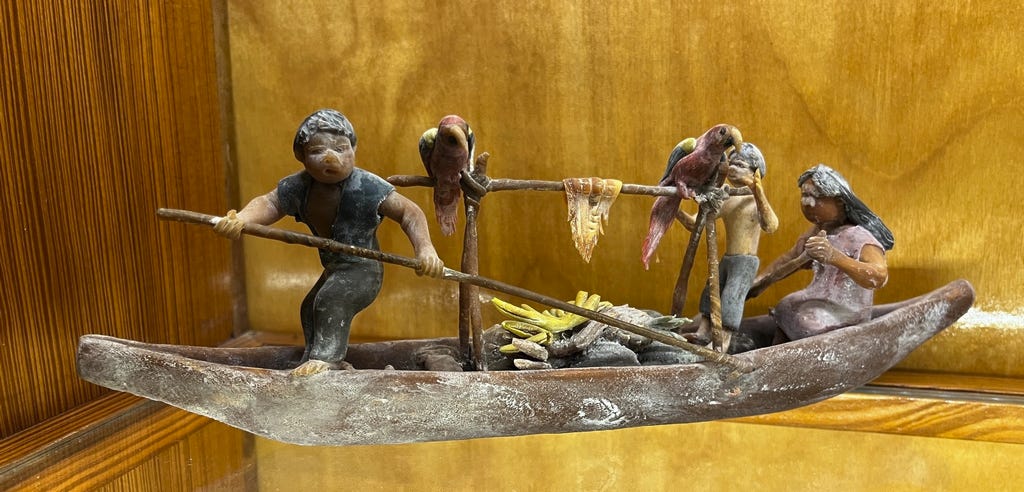
During four days we walked four different transects to get a feeling for the forest types of Iwokrama. But Iwokrama contains a million acres of unbroken, pristine forest ranging from flood plain to the the steep granite Iwokrama Mountains. How can one get a feel for such an immense and complex environment?
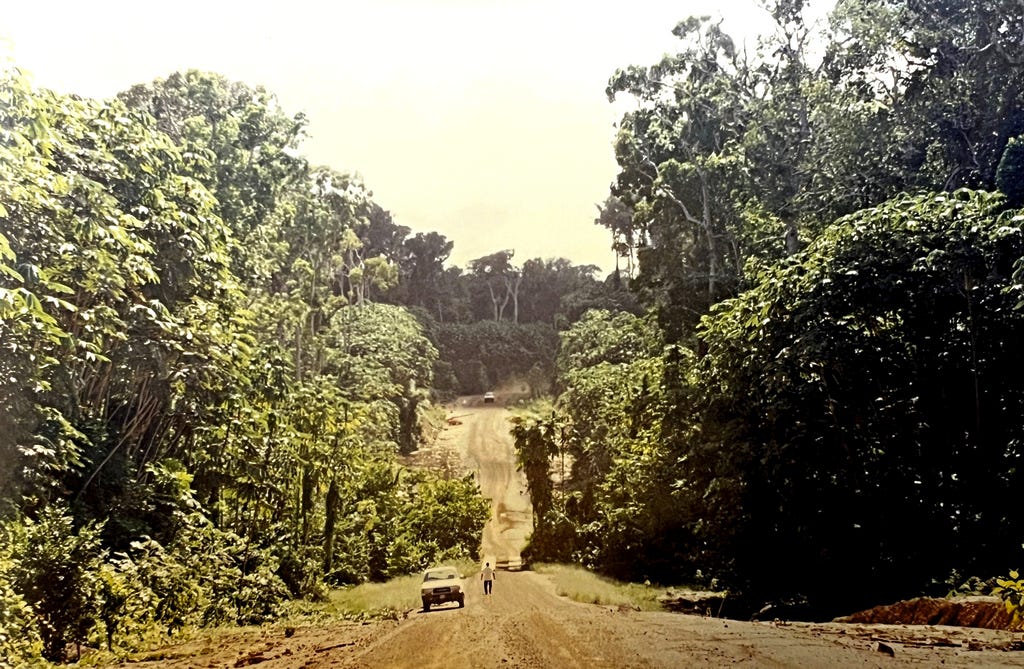
Access to Iwokrama is a major problem, as we had just experienced. The Georgetown-Brazil laterite road traverses the site, but the 20 km missing link north of Iwokrama makes access from Georgetown almost impossible except by Bedford military-style trucks. The Burro-Burro River is navigable by small boat and cuts the site in half. The mighty Essequibo forms the eastern boundary but navigation is hampered by rapids. Finally, almost all the other boundaries are formed by other rivers or creeks. But in between these are vast stretches of untouched forest, much of it flooded during the rainy season.
Hunting and fishing is mostly done by bow and arrow. Guns and ammunition are too expensive. Our guide, Daniel, always had a bow and arrow in his hand as we boated up the river and walked in the forest. Occasionally he would disappear off the transect and track some bird or agouti. One time, on the way back he trailed behind with Felix as the rest of us came upon a 40 cm long terrestrial turtle. Someone said, “Quick, hide it off to the side, otherwise it will be soup tonight”. So, David carried it ten meters off the line we were following. When we arrived at the car later, Daniel looked at us mischievously and muttered “I found it”. We were amazed. These are truly forest people.
When we had started the walk that day, we had laced up our boots. At the same time Daniel had kicked off his plastic thongs and proceeded barefoot. He navigated by the subtle landmarks of this flat forest. Ivan, in contrast, periodically took readings on the GPS (Geographic Positioning System) a technical marvel which searches the sky for three satellites and gives latitude and longitude with an accuracy of 18 meters (WRT note: 20 years later, I used GPS to map harvester ant colonies with a precision of 50 cm).
One of the greatest pleasures of these walks in the forest was drinking out of the occasional creek. It has been years since I have dared to do so, because the possibility of infection exists almost everywhere nowadays. A symbol of the isolation of this area. Lots of tracks of wildlife, of course: peccaries, deer, agouti. I found a crocodile skull in a dry creek bed. Spider monkeys attacked us with branches and tried to piss on us. The howler monkeys were less aggressive and stopped their racket as we got close. The “Captain” of Kurupukari had a pet otter. Pairs of noisy macaws fly overhead so often that they just seem to be part of the landscape. At a wooden bridge that needed repair, we startled an anaconda that slithered away into the aquatic grasses.
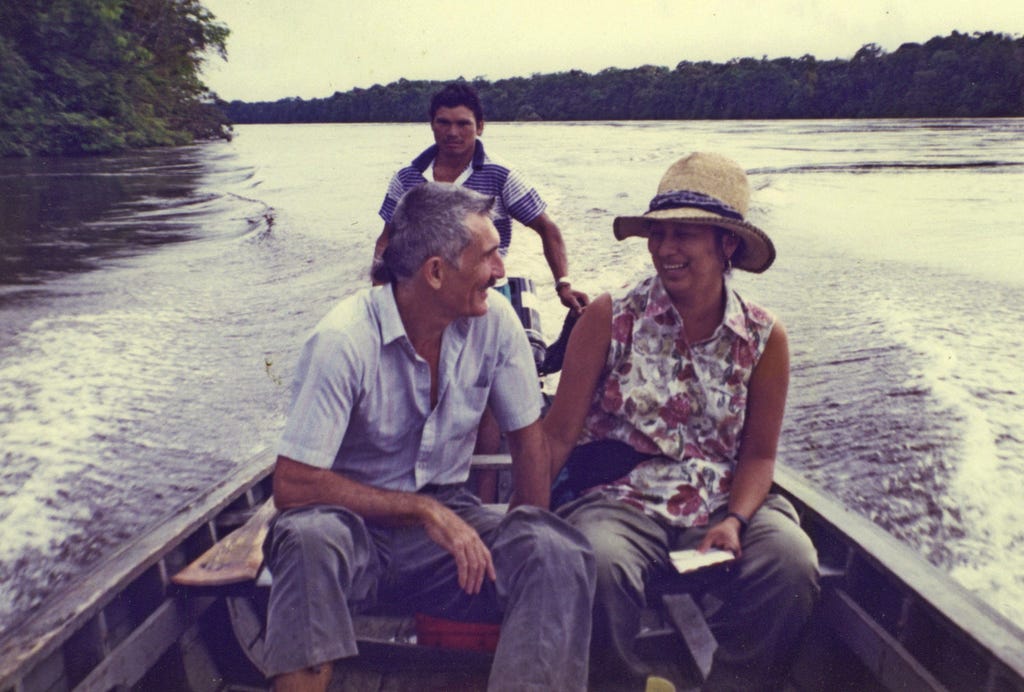
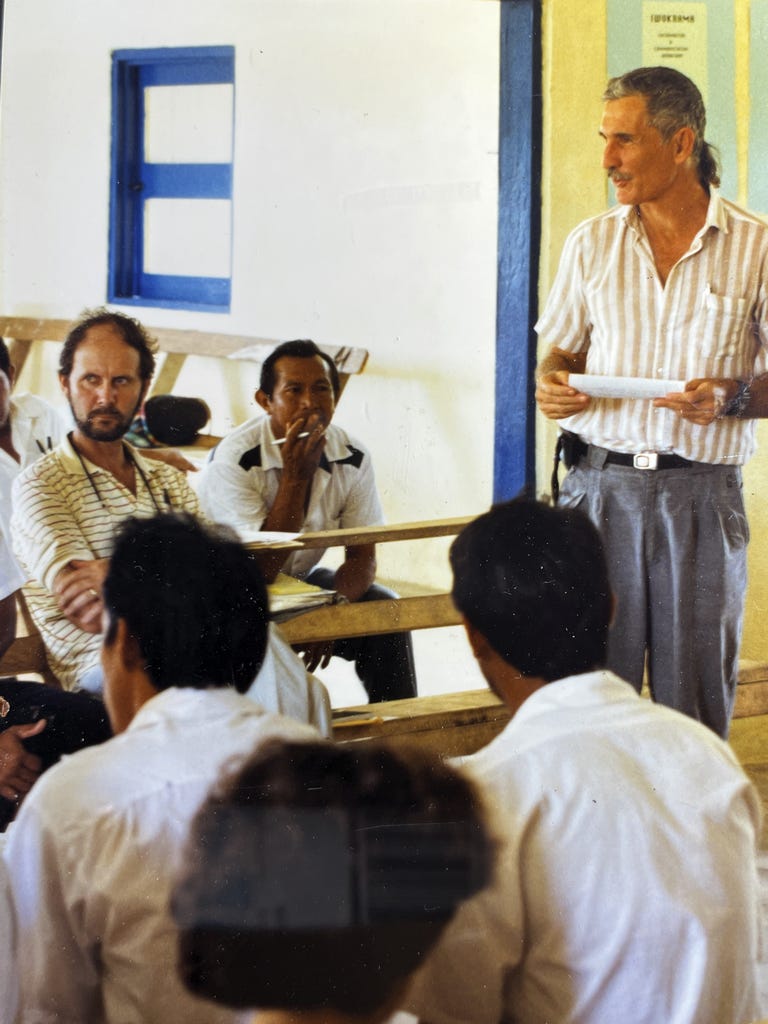
The week passed with more excursions, discussion of plans with Fred, perusal of his lengthy wish list of supplies to be shipped in, a visit to the teacher we had hired for Kurupukari Village, just a kilometer away. At a meeting of the villagers, I explained the plans the Iwokrama Programme had for managing the forest, the prospects of more work for them and tried to address their concerns.
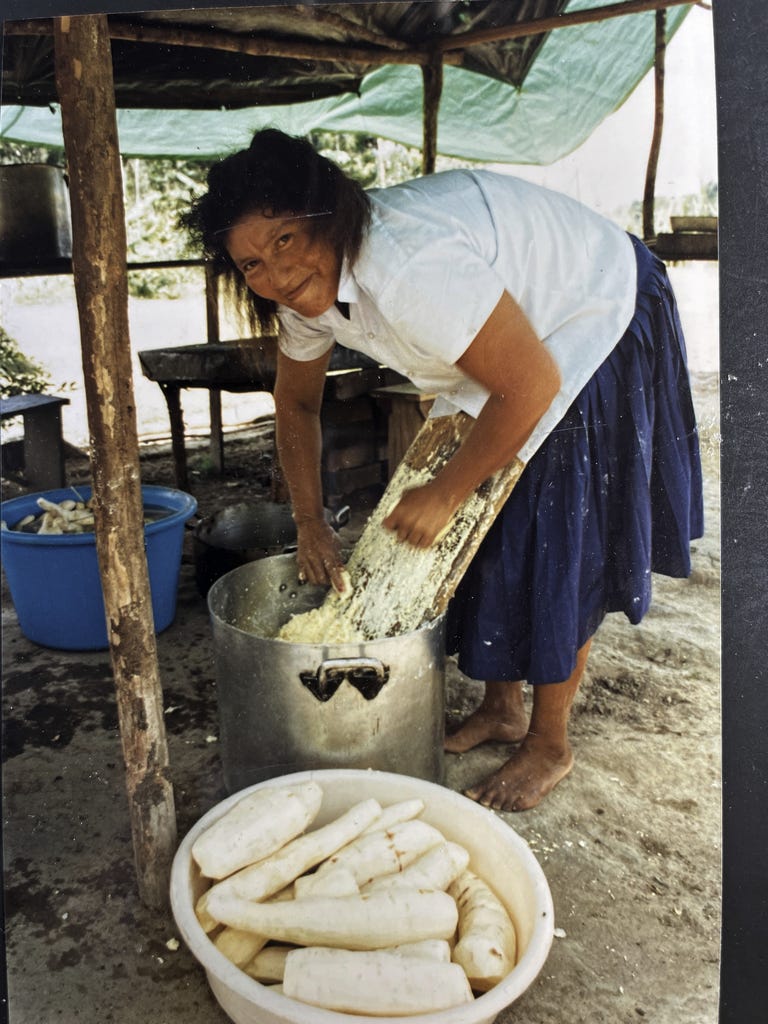
When there was no excursion, María helped Mrs. Allicock and learned how to grind, soak and roast the cassava to remove the poisonous cyanide.
When María and I were scheduled to fly out, Jameer drove us the two hours to the airstrip at Annai Village, playing his Patsy Cline tape on the radio. The road traversed the undisturbed forest. The noise of our jeep frequently startled the vivid parrots, the mates flying in pairs, streaking and squawking above us, scolding us for intruding in their realm. At one point, I counted 13 of these magnificent birds sitting in the crown of a tall tree. Rounding a curve, Jameer stopped the jeep. “Look! Do you see the jaguar sitting there?” The cat looked at us with curiosity, then majestically disappeared into the underbrush. Later, the enclosing forest abruptly gave way to the savanna with its big sky that we scanned for the tiny speck of an airplane as we waited in the mid-day heat.
The twin engine Islander banked one turn around the airstrip to be sure no cows were lounging on it, touched down gently, then in a cloud of dust furiously revved the engines with reversed propellers so as to bring it to a stop just before the end of the strip. The plane was heavy with more supplies for the forest station, mostly fuel for the outboard engines and trucks; sacks of flour and sugar, canned goods, spare parts and other essentials.
“Hello, Captain Chan,” I greeted the pilot. “Will we be full on the way out?” “Not really, Mr. Henry. Gonna have a light load. No other passengers.” Hesitatingly, I inquired, “Would it be possible to make a short stop at Kaieteur Falls? Neither María nor I have ever been there.”
I buckled myself into the copilot seat, always my favorite place when available. Below us, Annai Village became smaller; the savanna gave way to closed forest broken by the occasional river. After an hour, the plane followed the escarpment to our left, made a circle above the fall and landed on the airstrip at the top. The 113 meters wide Potaro River, plunges 226 meters in a single drop, making Kaieteur one the most powerful waterfalls in the world. In awe, we ventured out to the ledge that jutted out into space on the side of the fall. With a queasy feeling, I dangled my legs over the edge and for a long time marveled at the roiling thunder below.
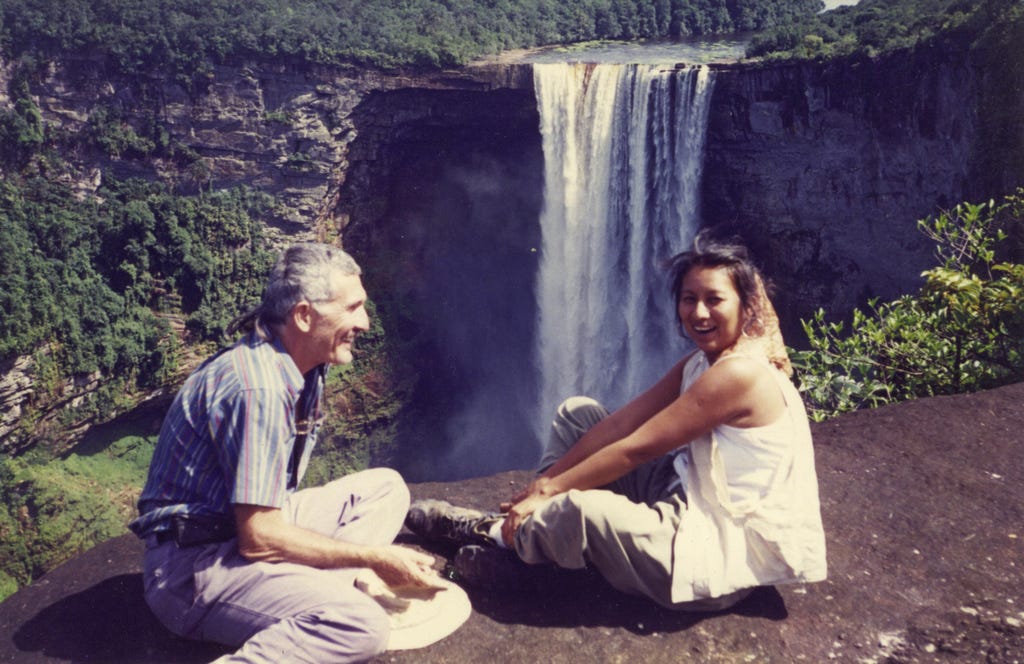
The plane then followed the Potaro River from below the falls to its confluence with the Essequibo River that we had just left a few hours ago. Soon we could see Georgetown and the Caribbean beyond. I did not want to land. I longed to go back to the realities of the forest and rivers we had just left. Regrettably, responsibilities and other realities pulled me down to a rough landing on the asphalt of Ogle Field.
My dream of spending a lot of time in the forest while getting management started remained a dream. My main job was organizational and political with the aim of deriving enough income from the forest to at least cover the cost of protecting and managing it. Aside from the traditional timber, other sources of income to explore were other forest plant products, tourism and scientific study. To achieve this aim requires research, demonstration, and markets, as well as training local staff. Success could have wide application far beyond Guyana, and that will be an acceptable trade-off.
Two eloquent brothers! Thank you for sharing Henry’s life and experiences. Can we hope that not too much has changed in these pristine places?
Nice read. Not sure I ever told you that my first trip to the tropics was to Guyana in 1997. A professor in my department was Guyanese and had/has his own smallish field station somewhat near Georgetown. We also took extended rides in Bedford trucks, drove past Linden and the shockingly barren lifeless bauxite mines to some coastal savannah sites, name of which evades me right now. We also flew to Kaieteur Falls, our pilot was also named Chan, Chan-a-Sue, Malcolm I think. RAF trained with a Scottish wife, local legend. We went to their house, large house in Georgetown. Water came from a tank on the roof. Interior looked very English, almost out of place in the tropics. Anyway, maybe the same Chan? I was there also with Jim Hunt, we'd pay the locals out in the bush GUY$100 to find various wasp nests. Pretty sure they'd eat the larvae, they never said or offered but the nests were often coated with honey on the inside, so they might have been tasty.