Desert Washes
getting carried away

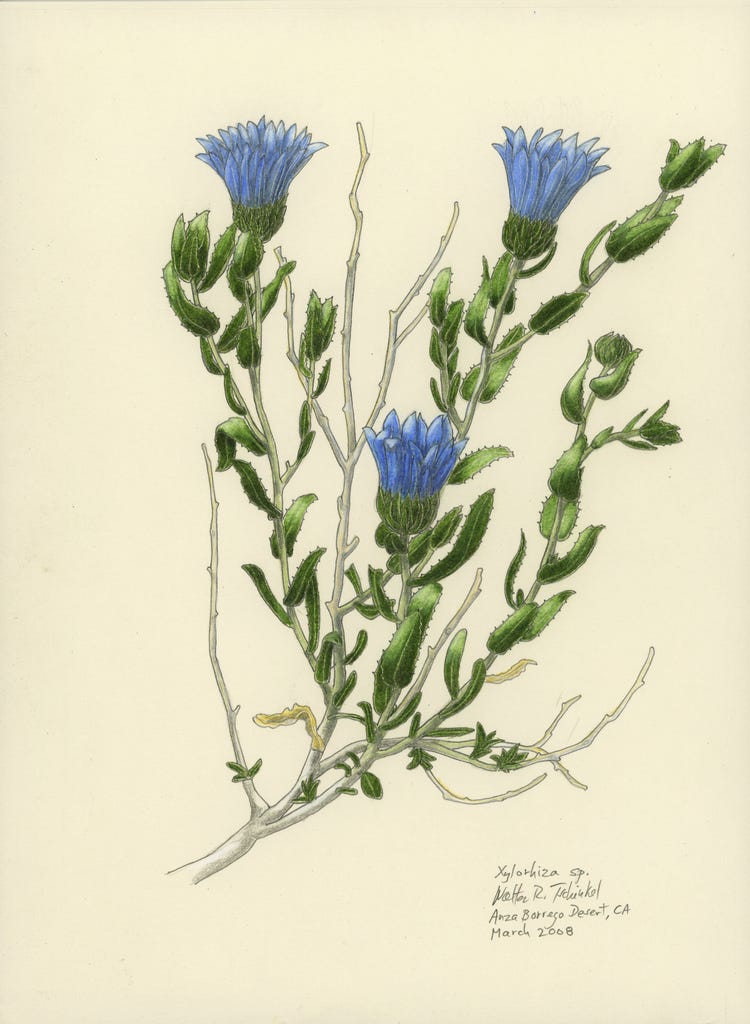
In the Anza-Borrego desert, woody aster bushes with their sky-blue flowers and stiff, brittle stems prefer the edges of dry washes. On our dirt-road desert drive, their beauty entices us to stop for a sandwich break. Sitting on the sandy bank, dry as it is, it is hard to imagine that all that we see before us is evidence of past transport by water —- braided patterns of stream beds that probably haven’t carried water in a century. As rare as rain may be, this landscape was formed by rainstorms in episodes of erosion, transport and deposition, relentlessly moving sand, rocks and gravel incrementally downhill. Thus the cut bank where we sit exposes alternating layers of gravel, sand and pebbles, all sorted by size.
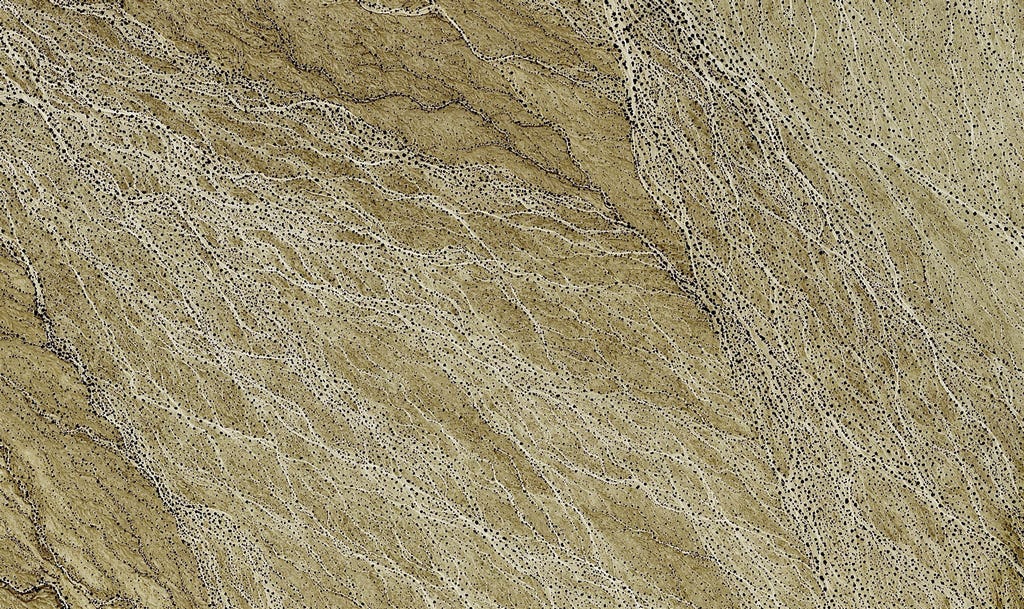
All landscapes are shaped by the relative rates of two processes that occur at vastly different scales of time and space—-on the one hand, the slow, molecule by molecule weathering that crumbles rock into soil, and soil into solute, and on the other, the rate at which these granular and soluble products are moved farther downhill by water (or wind), to be deposited eventually in the sea (or in a closed basin as in the Great Basin of Nevada, Oregon, and western Utah).
These multiple forms of transport occur at vastly different scales of time and space. At the lower extreme is the scale of microns to millimeters, milliseconds to minutes: a raindrop splashes down like an Apollo capsule on a square centimeter of sloped soil, sending a starburst of smaller droplets outward, deranging the soil particles into a moon-like crater half a millimeter deep. Gravity pulls at both the displaced grains and the spray of radial droplets so that they come to earth a millimeter or two farther down the slope, a difference noticeable only with a microscope. Sometimes gravity acts alone, giving a micro-nudge to tumble unstable grains down a micro-hill. Much of this transport is small in comparison to the landscape being moved, but multiply these small to tiny down-slope derangements a trillion-trillion-fold, and the entire surface layer of soil actually flows down the hill as a fluid in ultra slow motion, like a flood of cold molasses. This downslope creep is especially apparent in climates in which the soil undergoes cycles of freezing and thawing. Over millions of years, the peaks gradually decrease in elevation, the slopes become gentler and the mountain slowly flows into the sea, flattening the landscape.
In the deserts of the world, transport sometimes, though rarely, occurs at the other extreme of scale--- huge, violent and catastrophic. An earthquake sends a whole mountainside into the valley, a drenching thunderstorm dumps an ocean of water in a few minutes and a surging flood scours a canyon, tumbling boulders the size of houses before depositing them out on the alluvial apron in a mile-wide swath of debris and gravel. In heavy rains, water flows over surfaces as sheets, dislodging loose material an acre at a time, and moving it to lower elevation, or into a stream channel where it can cut, scour, and deposit. The wash in which we eat our sandwiches and admire the blue aster has been visited by such floods many times over millennia, each time moving a bit of mountain a step closer to the sea. In the Anza Borrego Desert, the rainstorm of 2013 swept alluvium five miles down from the mouth of Glorieta Canyon, a white scar still faintly visible in 2026.
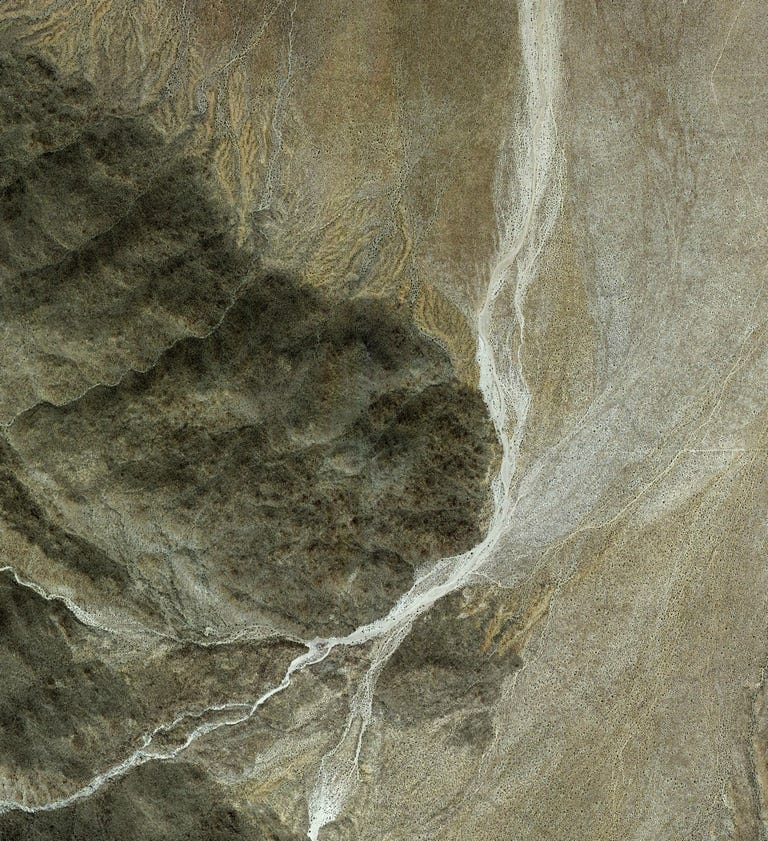
When transport by water is faster than the formation of new soil by weathering, we see the gentle, rounded landscapes of humid, rainy zones like eastern North America. But in deserts, rock crumbles into soil faster than water can clear the valleys and move it downhill, and mountains become buried up to their necks in their own waste, only the peaks peering out from under their wide skirts of trash.
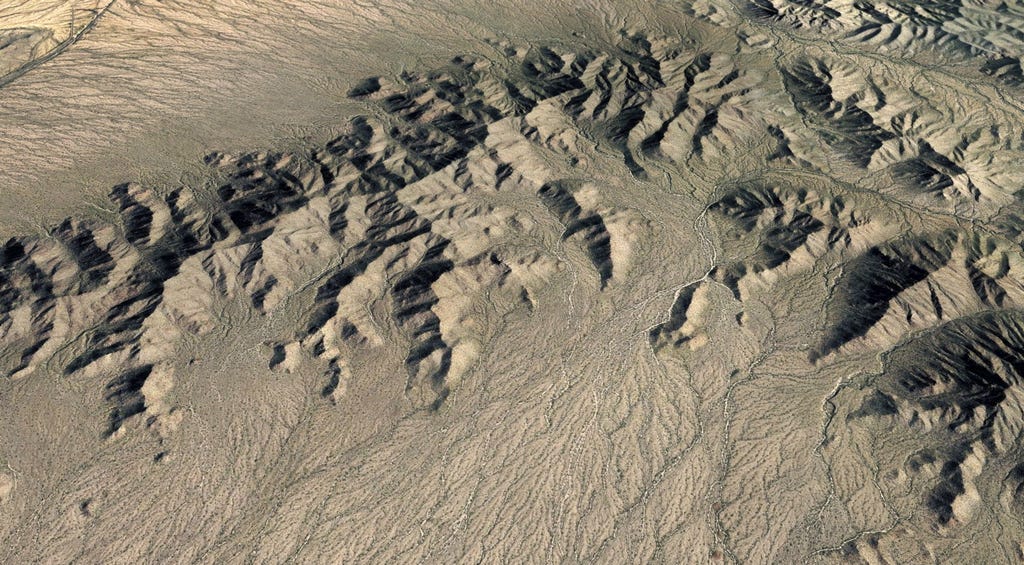
As the weight of the mountain decreases, it slowly floats upward to compensate for the lost mass, while the valley sinks under the weight of thousands of feet of sand, gravel and rocks, waiting to be moved farther downhill by the ephemeral, braided streams that feed the valley layer-cake.
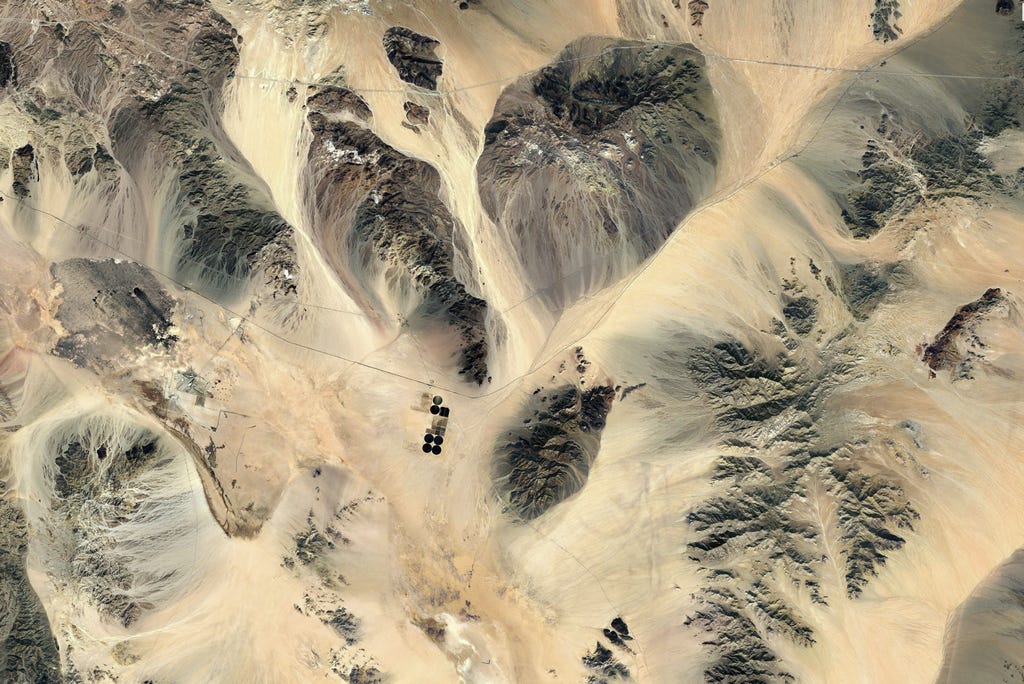
In our every-day human reality, we can hardly imagine the time scale of this geological drama, but this unimaginable drama created the scene where we eat our sandwiches among the blue woody asters.
Thank you for another great article. I never thought about how erosion works on the microscopic level.